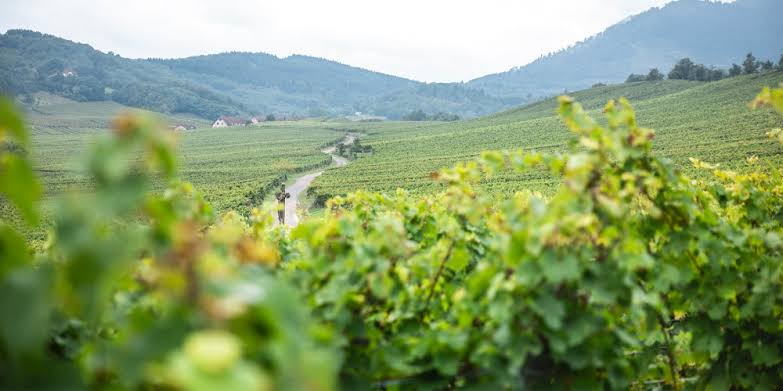
Nothing defuses AI’s threat to human creativity like a dose of Ostertag. The third-generation estate kicked into an extraordinary avant-garde gear when Arthur Ostertag’s non-conforming father André took over at the age of 21. Refreshment came in the form of biodynamically farmed wines that shut out all the noise and listened only to nature. The vital, energetic wines have always had a joie de vivre while expressing that precious thing that so often eludes wine: Truth!
We’re not talking about truth as something strict and earnest; we’re talking about transparency laying bare the flair and personality of grapes beautifully grown in Alsace’s unique dips and folds. Arthur brings incredible instinct to his role as third-generation custodian here. But what makes these wines so very special is a sense of taste—or feel, perhaps—coupled with acute intelligence.
Even to the most devoted farmers, nature doesn’t give an easy ride. But there’s a truth in the vines waiting to be teased out. The Ostertag way—a path Arthur has beaten to arrive at even more exalted ground—is to realise wines in their fullness. There’s a reason you don’t have to think about Arthur’s wines. They are a jigsaw falling into place.
The new shipment includes three new Vins de Fruit: the latest edition of the super old-vine Sylvaner, and the Les Jardins Riesling and Pinot Noir (yes!). And there are three Vins de Pierre Rieslings. This year’s edition of the one-off Exutoire bottling is from the Heissenberg vineyard. We also have the 2024 wine from the underrated Clos Mathis site. And the stupendous ’23 Muenchberg grand cru tops off the offering.
This is natural intelligence of the highest order—the kind to restore your faith in humanity.
THE WINES – VINS DE FRUIT
2022 Ostertag Les Jardins Pinot RRP $64
75% Pinot Blanc/Auxerrois Blanc, 25% Pinot Gris
The Vins de Fruit are wines that emphasise the grape’s expression rather than a specific terroir expression. They are not limited to a single site or soil type, and instead embody the intricate parcellation and diversity of Alsatian terroirs that exist even in a small area like a single village.
The 2022 vintage shows charm and elegance, a slightly warmer growing season, which resulted in a ripe and expressive wine with good concentration. The wines are organically farmed with a biodynamic approach, which adds purity and vibrancy.
There are aromatic notes of white flowers, citrus and stone fruits from the Pinot Blanc component and texture from the Auxerrois, with Gris adding weight and extract to the long and delicious finish.
2024 Ostertag Riesling Les Jardins RRP $69
The Vins de Fruit are wines in which the primary expression of the grape variety takes precedence over the notion of terroir, which is considered at village level. They express the diversity of soils that exists even within a single village. Riesling Les Jardins is a blend of around a dozen different parcels located around the estate, principally in the commune of Epfig, all farmed biodynamically. In a sense, it is our village Riesling and provides a good introduction to the estate’s different crus, with most of the parcels situated on gentle slopes with light soils that reflect the geology of the estate’s lieux-dits. The soils are varied, comprising clay, sandstone, sand and volcanic deposits. This Vin de Fruit captures the personality of the village’s predominantly sandstone terroirs, giving the wine delicacy and sapidity.
In 2024, a warm late season allowed us to harvest in early September under perfect conditions. The result is even greater complexity in this cuvée, with increased mineral structure and ageing potential, while retaining a generous, sapid profile that is very approachable in its youth. The grapes were gently pressed as whole bunches in a pneumatic press over nine hours. Fermentation took place spontaneously with indigenous yeasts in stainless steel tanks. The wine underwent malolactic conversion, as do all our wines, and was aged for one year on its lees, again in stainless steel. It was bottled on 3rd September 2025 with 12% alcohol and 0.63g/L natural residual sugar. The wine is dry and certified organic and biodynamic.
The result is a Riesling with delicate aromas of white flowers, white peach and flowering vines. The palate is generous and mouth-watering, with fine, persistent acidity and an almost saline sensation on the finish. The wine expresses all the grace of a Fruit Riesling, with a dimension approaching that of the estate’s Riesling de Pierre, although without the same depth and density. – Arthur Ostertag
The 2024 Riesling Les Jardins, grown on sandstone and clay, opens with smoky notes of tart apple. The palate is crunchy, tender, tart, bright and poised. This is snappy, light and vivid, with wonderful elegance. (Bone-dry) 92 points. Anne Krebiehl MW, Vinous Jan 2026
2024 Ostertag Sylvaner Vieilles Vignes RRP $64
Sylvaner is a grape variety originating in Central Europe, specifically Transylvania, from which it takes its name. It is also grown in Germany, particularly in Franconia, with Alsace marking the western limit of its historical range. Traditionally, Sylvaner has been the cornerstone of Alsatian cuisine, used in marinades for Baeckeoffe and in the cooking liquor for Choucroute. Once accounting for almost one-third of Alsace’s total wine production, it now represents only around 6% as vineyards have increasingly been replanted with Pinot varieties and Riesling. Domaine Ostertag has long championed Sylvaner as an everyday wine of genuine quality, produced with restrained yields and a clear commitment to viticultural and winemaking excellence.
The estate’s Vieilles Vignes Sylvaner has an average vine age of 55 years, with vines ranging from 30 to 80 years old. The vineyard has been farmed biodynamically since 1998, alongside the rest of the estate. The vines come from a range of plateau and hillside parcels, with around half classified as lieux-dits, mainly in the village of Epfig, on clay and sandstone soils with limestone, marl and granite.
The old vines have developed deep root systems that give the wine surprising mineral structure and considerable depth of flavour for the variety. Although it can be cellared for several years, it offers its greatest enjoyment in the freshness and vitality of its youth.
The 2024 vintage was bottled on 1st September 2025. Whole bunches were gently pressed in a pneumatic press over nine hours, then fermented slowly with indigenous yeasts. The wine was matured for one year on its lees in stainless steel tanks. It has 12% alcohol and 0.89g/L residual sugar. The wine is dry and certified organic and biodynamic. – Arthur Ostertag
Apple, mint, a slight nutty fino-like tang, discreet floral top notes. It has wonderful texture with a chalky grip, but also has a honeyed glossy softness, cut into shape by bright but balanced acidity, finishing fresh, saline and long. Flat out delicious. A wonderful wine. 94 points. Gary Walsh, The Winefront Oct 2026
The 2024 Sylvaner Vieilles Vignes is made from vines rooted in loess, marl and sandstone that are up to 85 years old. Lanolin and apple are equally supple on the nose. The concentrated palate offers an engaging texture that is creamy and pithy at the same time, with supple freshness and smooth fluidity. Everything here feels understated and quiet but profound, with lovely poise. (Bone-dry) 94 points. Anne Krebiehl MW, Vinous Jan 2026
2025 Ostertag Pinot Noir Les Jardins RRP $75
The Les Jardins Pinot Noir is part of Ostertag’s Les Vins de Fruit range, in which the primary expression of the grape variety takes precedence over the notion of terroir, explored at the scale of a single village. It reflects the fragmentation and diversity of Alsace’s vineyards, even within a small geographical area. The wine is a blend of fruit from three small biodynamically farmed vineyard plots on the plateau overlooking the village of Epfig. The soils are based on sandstone bedrock, with varying proportions of clay depending on the site. Pinot Noir in Alsace was long treated as a white grape variety and used primarily for rosé production, which did little for its reputation. Over the past decade, however, the region has undergone a transformation, with Pinot Noir increasingly recognised for its potential to produce serious red wines.
At Domaine Ostertag, the greatest focus is in the vineyard. For Pinot Noir, the challenge has never been achieving natural ripeness—the estate has not chaptalised since 1992—but obtaining fully ripe tannins. For more than 30 years, Pinot Noir has been managed as a distinct grape variety, including a different pruning approach designed to reduce yields further, improve bunch aeration and increase sun exposure. Fermentation includes a maceration of around 10 days at approximately 26°C with a small percentage (roughly 15%) of whole bunches. The wine matures in stainless steel until late spring to preserve freshness and crunchy fruit character, with only the press wine matured in barriques.
Les Jardins is intended as a pure expression of Pinot Noir fruit from the village of Epfig, combining freshness, brightness and immediacy. Certified organic and biodynamic. – Arthur Ostertag
SINGLE VINEYARD – VINS DE PIERRE
2021 Ostertag Fronholz Pinot Gris RRP $114
Fronholz is a very distinctive terroir with a strong personality. It stands out due to its unique location on a hill set apart from the Vosges mountain range, situated on the summit and southwest slope of the Epfig hill. But it is also unique because of its rare southwest exposure in Alsace (where the Vosges typically form the western edge of the vineyard zone). The result is intense evening sunlight and greater light intensity overall (better photosynthesis, more aeration). Acids are preserved and aromas are not overcooked.
Fronholz has long been recognised as the finest terroir in Epfig, and a classification application for premier cru status is being prepared. Today, the entire hill is grouped under the Fronholz lieu-dit, even though the soil composition differs between the top and bottom of the hill—hence the choice of different grape varieties depending on the area.
The 2021 Pinot Gris Fronholz was fermented and aged in used pièce. A hint of honeyed gingerbread plays around the juicy pear and yellow plum notes on the nose. The palate comes in with a smooth, flowing, energetic drive, like a cooling but powerful wave of energy and power, yet without heaviness. Lovely freshness sets an accent of juicy, zesty lemon peel. (Bone-Dry) 94 points. Anne Krebiehl MW, Vinous Jan 2024
2022 Ostertag L’Exutoire HR7 (Heissenberg Riesling) RRP $118
L’Exutoire is an outlet for the frustrations created by the meeting of water and fire, of freedom and reason. It is anything but rational, having been built up over days and nights—sometimes with impetuosity, but always with love. L’Exutoire has allowed me to free myself while also shaping me. From the vineyard to the cellar, it has taught me to confront realities, assert my desires and refine my perceptions.
It was on the Heissenberg that I was able to give free rein to my vision for this new 2022 vintage. The historic pink sandstone soil of this parcel is expressed in the wine. L’Exutoire HR7 (Heissenberg Riesling) was harvested in mid-September. The wine balances the richness of the 2022 Riesling vintage with the elegance of candied citrus from the Heissenberg.
Following a delicate, prolonged pressing in a pneumatic press, the wine was fermented and matured in stainless steel on its total lees for one year. It was bottled in early September 2023 with 13.5% alcohol and 0.44g/L residual sugar. The wine is dry and certified organic and biodynamic. – Arthur Ostertag
2021 Ostertag Le Berceau Riesling RRP $114
Le Berceau is a unique wine on account of its geology. It’s a blend of clay and pink sandstone, which gives the wine lacy texture and charming volume. The more it ages, the more the minerality improves the structure of the wine.
The vineyard is one hectare and I pick only 0.20Ha for this wine. The rest of the bunches are not ready to fully show the complexity of the place, so that fruit went into the Riesling Les Jardins. Every day we see the vineyard life progress, and we encourage this with a lot of plant preparation and biodynamic work to help the vines find their own balance. Epfig is a special village in the Alsace vineyard for many reasons. Its Roman-based name, to begin with, distinguishes it from most of the villages on the wine route with firmly Germanic names. It’s also far from being the most renowned, though it has the largest vineyard area in the whole region, with 550 hectares of AOC Alsace vines. Finally, while most towns hang on the steep Vosges foothills, Epfig spreads over the gentle slopes around the Fronholz hill. This is the central point of the town’s vineyard as well as our domaine’s historic terroir, a kind of resurgence set apart from the 3km-distant Vosges hillsides and entirely surrounded by flat land.
The domaine has always grown several gardens of vines in the Fronholz, but it’s only recently that we took root in the Pflanzer, another historic vineyard of Epfig, not too far from the Fronholz. Set in a more urban landscape, Pflanzer is a more intimate, smoother, more civilised kind of terroir. Its name means “nursery” for it was there that the baby vines were raised during their first year after grafting, before being permanently planted elsewhere. It’s a milieu, perfectly balanced and rich enough in clay to allow these delicate little beings to set their roots easily.
Located just down the Fronholz hill, its top part is a geological continuity of Fronholz (decomposed white sandstone, quartz and many heavy minerals), while the lower part has more clay and alluvium. We began working Riesling vines there in 2016, and they were bottled as a single-vineyard wine for the first time in 2018.
The impact of clay is obvious when comparing it to the other single-vineyard Rieslings that all come from higher, steeper and sandier soils that are rockier and poorer in clay. Fermented and aged in stainless steel where it relaxed on its lees for 20 months. Like all the domaine wines, it was gently pressed for 10 hours, then fermented with it natural yeasts and did full malolactic conversion. – Arthur Ostertag
The 2021 Riesling Le Berceau is from clay and marl soils. The nose is subtle with gentle, melted candlewax that, by and by, offers a touch of citrus. The palate is beautifully clear and bright but with a buffered freshness that combines clarity and lemon brightness. Purity comes with a distant promise of juicy, rounded stone fruit, while citrus still holds sway. The 2021 is smooth with a tangerine and citrus zest tingle on the dry finish. 92 points. Anne Krebiehl MW, Vinous Apr 2024
2024 Ostertag Clos Mathis Riesling RRP $114
Clos Mathis belongs to Ostertag’s long-serving former vineyard manager, Hubert Mathis. This remarkable 0.6-hectare vineyard, surrounded by stone walls, is located in Ribeauvillé, in line with the grand crus Geisberg and Kirchberg. The soil is composed of a granitic mother rock and gneiss, with poor fertility. The vines are grown on terraces, on a very steep south-east-facing slope which benefits from hot days and cool nights. The heat is tempered by cool winds coming down at night from the valley that ends just after the vineyard. This particular location allows slow ripening, preserving acidity and finesse in Riesling.
Hubert Mathis inherited this plot from his parents. He has entirely rebuilt it and was initially selling the grapes to a local merchant until 1997, when he and André decided to reveal this very beautiful historic vineyard, which has been esteemed since the Middle Ages and the time of the Seigneurs de Ribeaupierre.
The 1997, 1998 and 1999 vintages were dedicated to working on the soils and starting to farm the clos biodynamically, in order to reveal the soul of this beautiful terroir. The first vintage as part of the single-vineyard range of the domaine, under the Clos Mathis label, was 2000. Clos Mathis gives birth to classic, distinguished, long-lived Rieslings. Some aspects can make it seem austere in its youth: the structural elements (acidity, mineral tannins) are in the foreground while textural and aromatic elements are rather timid, but with time the Clos Mathis becomes a sappy, classically dry wine in the breed of greatest Alsatian Rieslings.
It was delicately airbag-pressed as whole bunches for nine hours, fermented with indigenous yeasts in stainless steel tanks, and was aged on its lees for a year. It’s a dry wine, certified organic and biodynamic. Time and aeration will allow the wines to unfold. – Arthur Ostertag
2023 Ostertag Muenchberg Riesling Grand Cru RRP $163
The name Muenchberg means “Mountain of the Monks” in the Alsatian dialect, as the vineyard was first planted in the 12th century by the Cistercian monks of Baumgarten Abbey, located below the slope. Muenchberg is one of Alsace’s most remarkable Grand Cru vineyards, thanks to its distinctive soils of pink sandstone and volcanic sediments dating back around 250 million years, as well as its striking natural setting. Situated above the village of Nothalten in a sheltered valley, it is surrounded by the sub-Vosges hills and protected to the west by the Ungersberg (901 metres). The vineyard forms a south-facing amphitheatre between 250 and 300 metres above sea level, where cooling westerly winds help preserve freshness, finesse and complexity in the wines. The Grand Cru covers 17 hectares, of which Domaine Ostertag owns 2.05 hectares, including 1.65 hectares planted to Riesling. The vines have been farmed biodynamically since 1998. In the central part of the vineyard, the oldest vines are around 75 years old and are known as the Vieilles Vignes Maman, having been planted by Irma Ostertag, the founder of the estate. Some parcels are planted at very high density using an old massal selection. Since 2015, horses have been reintroduced for soil cultivation in the Muenchberg vineyard.
The 2023 vintage was marked by a highly variable growing season, beginning with a cold, dry winter and spring. There was no rain until 19th June, after which temperatures rose significantly ahead of a warm summer. From August onwards, persistent rainfall led to severe powdery mildew pressure, reducing part of the crop. The Muenchberg vineyard was harvested during a heatwave on 4th and 5th October. Whole bunches were gently pressed in a pneumatic press over ten hours. Fermentation took place spontaneously with indigenous yeasts in stainless steel tanks, where the wine remained on its lees for 24 months. It was bottled in November 2025 with 12.5% alcohol, 2.1g/L residual sugar and 7g/L total acidity. The wine is dry and certified organic and biodynamic.
Muenchberg is a wine of remarkable nobility, length and depth, with a delicate yet generous texture. The balance on the palate comes from the complementary character of the sandstone and volcanic soils: the sandstone brings generosity and charm to the palate, while the volcanic soils provide tension, structure and the vineyard’s distinctive long, fine, almost saline finish. Although the wine is expressive in its youth after extended decanting, the terroir’s character is revealed most clearly after at least five years of cellaring. – Arthur Ostertag
The 2023 Riesling Muenchberg Grand Cru is grown on Triassic pink sandstone with some volcanic sediments and was made in stainless steel only, with 14 months on lees. Tender pear and slight smoke are subtle on the nose. The palate is bright, direct and drives forward with linearity and stoniness. This still has to come out of its shell but it is full of stony, taut promise. (Bone-dry). 95 points. Anne Krebiehl MW, Vinous Jan 2026
